Senior Air Traffic Controller Salary in Maricopa, AZ: $216,548 (2026)
Quick Answer:The top tier of air traffic controllers working in Maricopa, AZ — those at or above the 90th percentile — pull in $216,548/year or more for 2026, based on BLS OEWS 2025 estimates for SOC 53-2021. Strip back Maricopa's price premium (BEA RPP 98.5, 1% below national) and that top-decile pay carries the same buying power as $219,846 in average-cost America. The 43% spread above city median typically rewards 7+ years of practice or specialty credentials.
Based on BLS state-level estimates · View source
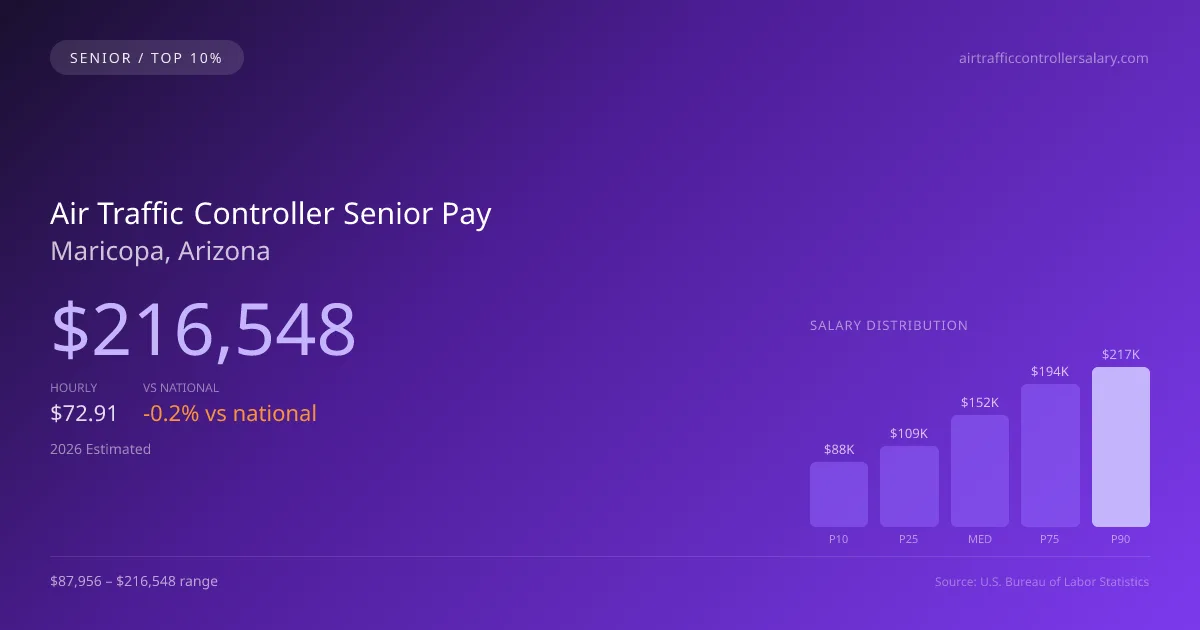
In 2026, senior air traffic controllers in Maricopa, Arizona, can anticipate a median annual salary of $151,649, with high-performing professionals earning significantly more. The top earners in this market, represented by the 90th percentile (P90), can make up to $216,548, while those at the 75th percentile (P75) can expect approximately $193,627. This impressive earning potential highlights the experience premium available to seasoned controllers, with substantial gaps between median figures and the compensation achieved by distinguished professionals. Attaining this upper echelon of pay typically requires years of dedication, advanced training, and a track record that demonstrates exceptional competence in managing complex air traffic scenarios.
About the Maricopa Market
Salary estimated from Arizona average ($138,000) adjusted for local cost of living.
2026 Salary Percentile Distribution in Maricopa
Experienced air traffic controllers at the top of the pay scale in Maricopa earn between $193,627 and $216,548 per year (2026 est.). This $128,592 range from 10th to 90th percentile reflects significant earnings potential growth over a career. The Maricopa median of $151,649 sits 0.16% below the US median.
Top ATC Salary Comparison
| Level | Maricopa | National |
|---|---|---|
| Median (P50) | $151,649 | $151,886 |
| 75th Percentile | $193,627 | $195,468 |
| 90th Percentile (Top 10%) | $216,548 | $221,151 |
In Maricopa, experienced air traffic controllers (P90) earn 42.80% more than the local median — reflecting the significant value of specialization and tenure in this market.
What Drives Top Air Traffic Controller Pay in Maricopa
Advanced Certifications in Arizona
AZ air traffic controllers with additional specialty certifications within the aviation field earn significantly above the $151,649 median. Expanded-scope credentials are increasingly valued by Maricopa employers.
Specialty Focus
Air Traffic Controllers focusing on high-acuity or specialty areas within the aviation field in Maricopa command premium compensation, often reaching the $193,627–$216,548 range.
Large Health-System & Multi-Site Experience
Large hospital systems and multi-site employers in the Maricopa metro area often pay above-market rates for experienced air traffic controllers who demonstrate efficiency and leadership.
Employer Loyalty & Patient Relationships
Long-tenured air traffic controllers in Maricopa with established relationships have strong negotiating leverage. In this developing market, retention bonuses and annual raises are common for top performers.
Continuing Education & Leadership
Air Traffic Controllers in Arizona who pursue advanced degrees, mentor junior staff, or lead clinical education programs position themselves for the highest compensation tiers and management roles.
Air Traffic Controller Career & Wage Growth Path in Maricopa
Clinical Air Traffic Controller
0-5 yearsSenior/Lead Air Traffic Controller
5-10 yearsAir Traffic Controller Department Manager
10+ yearsEducator / Specialty Leadership
AdvancedMaricopa ranks #12 of 33 Arizona cities for top earner air traffic controller salary (90th percentile: $216,548).
Top 10% air traffic controller compensation in Maricopa ($216,548) is 4.29% below the Arizona average P90 ($226,243).
2019 BLS Actual
$172,650
2025 BLS Actual
$211,122
2026 Current Est.
$216,548
2019–2027 Growth
+28.6%
Salary Trajectory for Air Traffic Controllers in Maricopa (2019–2027)
2019–2025: actual BLS OEWS data for this metro area. 2026+: CAGR 2.57% projection.
| Year | Annual Salary | Status |
|---|---|---|
| 2019 | $172,650 | Actual |
| 2020 | $180,934 | Actual |
| 2021 | $182,119 | Actual |
| 2022 | $185,849 | Actual |
| 2023 | $196,806 | Actual |
| 2024 | $196,651 | Actual |
| 2025 | $211,122 | Actual |
| 2026(current) | $216,548 | Estimated |
| 2027 | $222,113 | Projected |
Top-earning air traffic controllers (90th percentile) in Maricopa saw their compensation grow 22.3% from $172,650 in 2019 to $211,122 in 2025, based on 7 years of BLS OEWS data for this metropolitan area. At a 2.57% annual growth rate, senior-level pay is projected to reach $222,113 by 2027, reflecting continued demand for clinical expertise and expanded-function credentials.
Note: Historical values (2019–2025) are actual BLS OEWS figures for the Maricopa metropolitan area, sourced from annual Occupational Employment and Wage Statistics surveys. 2026–2026 figures are current estimates, and 2027 values are projections, calculated using a 2.57% CAGR derived from 7-year BLS historical data. Actual salaries may vary based on employer, experience, certifications, and local market conditions.
Maximizing Your Air Traffic Controller Earnings in Maricopa
Beyond raw salary figures, multiple factors contribute to the senior air traffic controller pay in Maricopa, AZ. Professionals with specialized skills, such as en route/radar operations or terminal radar control (TRACON), often command higher wages due to the intricacies involved in these roles. Compensation can also vary based on the employer type; FAA en route centers tend to offer the most competitive salaries, while military air traffic control positions present distinct career paths with their own benefits. Advancement within this profession follows a structured trajectory, moving from developmental controller to certified professional controller (CPC), and leading up to management roles or specialized instructor positions. Pursuing advanced credentials, such as enhanced training or certifications, along with additional responsibilities like traffic management coordination, can further elevate salary prospects. Non-salary compensation, including shift differentials and overtime, plays a significant role, especially in light of chronic staffing shortages that have prompted increased workloads and extended hours for experienced controllers in the industry.
More salary data for Maricopa, AZ:
Frequently Asked Questions
How much do experienced air traffic controllers make in Maricopa in 2026?
What drives higher air traffic controller pay in Maricopa?
What certifications boost air traffic controller salary in Maricopa?
Can experienced air traffic controllers make six figures in Maricopa?
How much does air traffic controller salary increase over time in Maricopa?
Related Pages
Compare Salaries
Career Resources
Nearby Cities in Arizona
Written by Jordan Lee, ATO
Career Analyst
Jordan has 10 years of experience as an air traffic controller. He specializes in terminal area control at a major airport.
Methodology & Data Source
Top-earner salary figures on this page are 2026 projections derived from the Bureau of Labor Statistics Occupational Employment and Wage Statistics (OEWS) survey, May 2026 release. BLS reported a 90th percentile salary of $211,122 for air traffic controllers in the Maricopa metro area. A 2.57% compound annual growth rate (CAGR), calculated from 6-year national BLS wage trends, was applied to project current 2026 senior-level compensation. Individual earnings depend on certifications, specialization, practice type, and years of clinical experience.
Data Sources & Methodology
Salary data for Maricopa is estimated from official BLS state-level occupational wage data (2025), adjusted for regional cost-of-living differences using BEA RPP (Regional Price Parities).
2026 figures are projected from 2025 BLS data using a compound annual growth rate (CAGR) of 2.57%, derived from historical BLS wage trends for air traffic controllers (SOC 53-2021).
Compiled and verified by Jordan Lee, ATO, a licensed air traffic controller with 10+ years of clinical experience. · View source data at BLS.gov